Florida’s rental market continues to favor tenants in many areas, but the statewide numbers conceal substantial regional differences. New apartment supply remains the dominant influence, increasing competition and limiting landlords’ ability to raise rents.
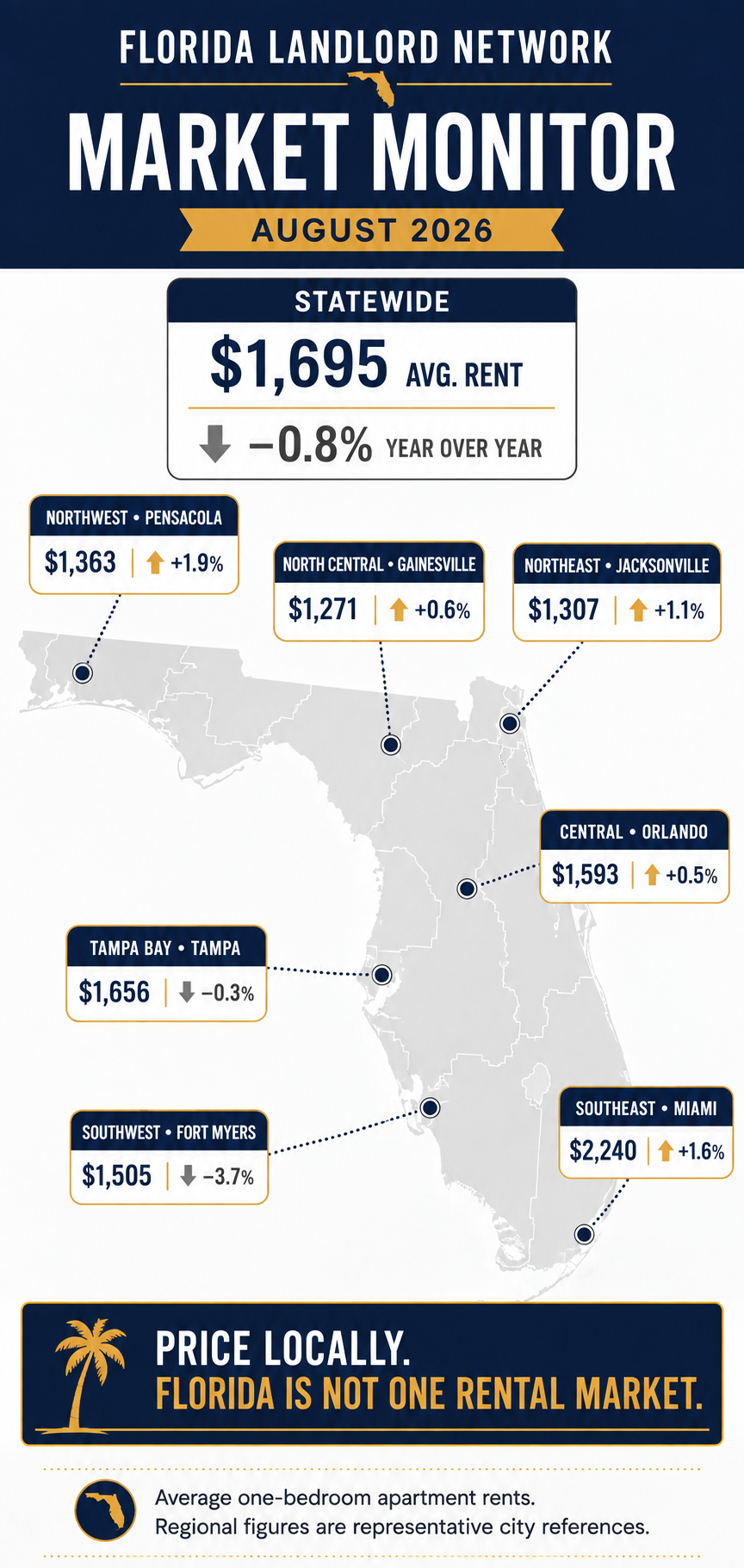
According to Apartments.com, Florida’s average one-bedroom apartment rent was $1,695 in August, down 0.8% from one year earlier. That statewide average provides useful context, but landlords should never use it alone to price an individual property.
A rental in Pensacola, Gainesville or Jacksonville faces very different conditions from one in Miami, Tampa or Fort Myers. Property type, neighborhood, condition and nearby competition remain more important than any statewide statistic.
Regional Market Snapshot
| Region | Representative Market | Average Rent | Annual Change | FLN Reading |
|---|
| Northwest Florida | Pensacola | $1,363 | +1.9% | Firm |
| North Central Florida | Gainesville | $1,271 | +0.6% | Balanced |
| Northeast Florida | Jacksonville | $1,307 | +1.1% | Improving |
| Central Florida | Orlando | $1,593 | +0.5% | Competitive |
| Tampa Bay | Tampa | $1,656 | −0.3% | Soft |
| Southeast Florida | Miami | $2,240 | +1.6% | Firm but expensive |
| Southwest Florida | Fort Myers | $1,505 | −3.7% | Weak |
The figures above generally represent average one-bedroom apartment rents in the named city. They are regional reference points—not valuations for every rental property within the region.
Northwest Florida: Pensacola Remains Firm
Northwest Florida is one of the stronger areas for landlords this month. Pensacola’s average one-bedroom apartment rent reached $1,363, an increase of 1.9% over the previous year.
Military employment, tourism and a more limited supply pipeline continue to support demand across the Pensacola area. Nevertheless, conditions can vary considerably between Downtown Pensacola, Ferry Pass, Gulf Breeze and communities farther inland.
Landlords retain reasonable pricing power, but properties must still be positioned competitively within their immediate neighborhoods.
View Pensacola rental-market data
North Central Florida: Gainesville Is Balanced
Gainesville’s average one-bedroom rent was $1,271, approximately 0.6% higher than one year earlier. The University of Florida, healthcare employers and government-related employment provide a dependable foundation for rental demand.
This market is relatively balanced rather than exceptionally strong. Student-oriented properties operate on a different leasing calendar from conventional apartments and single-family rentals. Landlords serving students must pay particular attention to preleasing periods, school schedules and competition from newer apartment communities.
View Gainesville rental-market data
Northeast Florida: Jacksonville Shows Improvement
Jacksonville provided one of August’s more encouraging signals. The city’s average one-bedroom apartment rent was $1,307, up approximately 1.1% year over year.
Jacksonville spent an extended period absorbing newly constructed apartments. The positive annual movement may indicate that supply and demand are moving closer to balance, although the market remains highly neighborhood-specific.
Jacksonville Beach, St. Johns County and portions of Clay County may perform differently from urban Jacksonville. Landlords should compare their property with rentals of the same type and in the same general location.
View Jacksonville rental-market data
Central Florida: Orlando Remains Competitive
Orlando’s average one-bedroom apartment rent was $1,593, an increase of approximately 0.5% from the previous year.
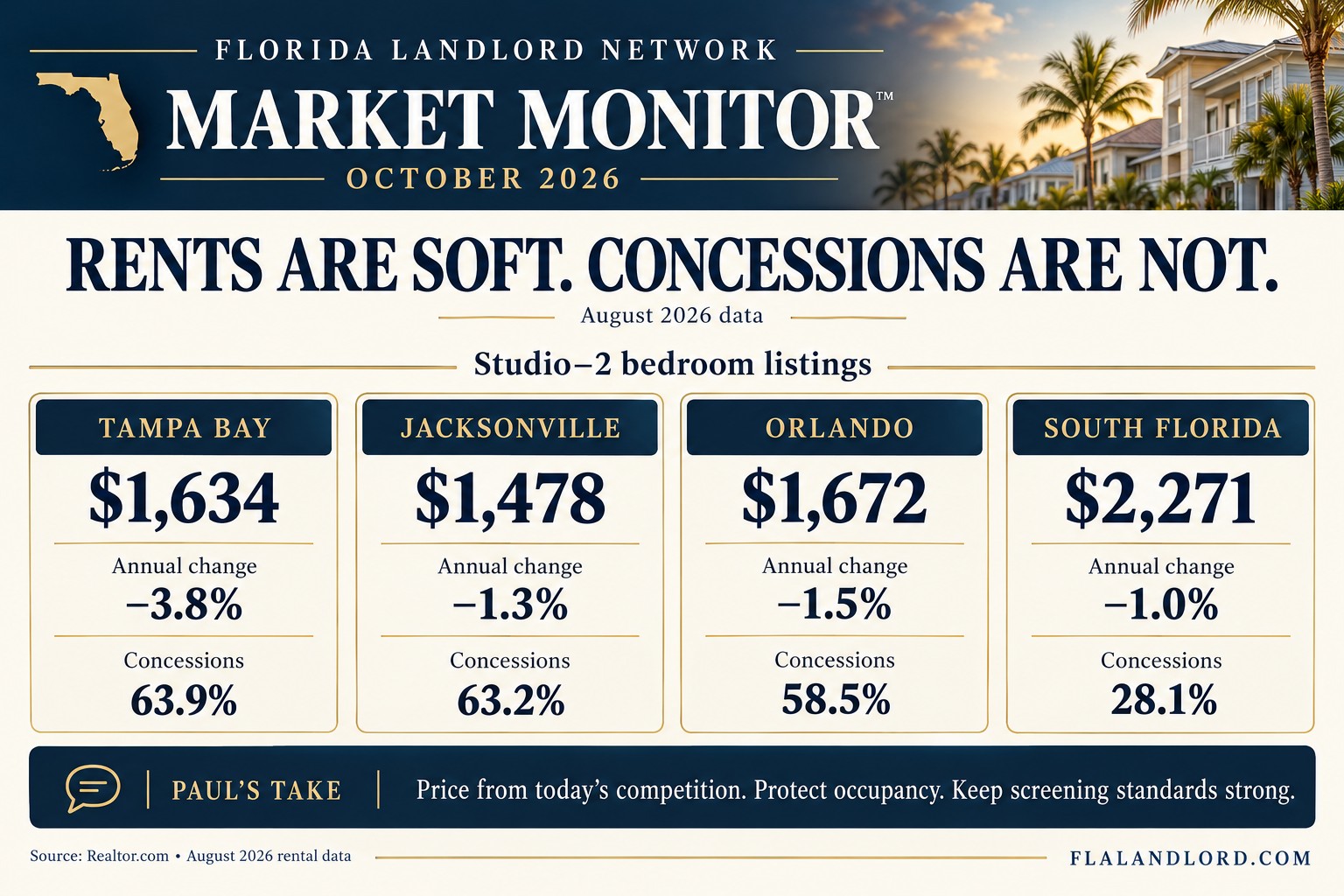
That modest increase should not be mistaken for strong landlord leverage. Orlando renters continue to have substantial choices, with more than 13,000 apartments advertised when the August data was compiled. Newer communities frequently use concessions to compete without reducing their advertised base rents.
Tourism, healthcare, technology and continued population growth support long-term demand, but landlords with current vacancies must respond quickly and price realistically.
View Orlando rental-market data
Tampa Bay: Supply Continues to Restrain Rents
Tampa’s average one-bedroom apartment rent was $1,656, down approximately 0.3% year over year.
The decline is modest, but it reflects the competitive environment created by recent apartment construction throughout Hillsborough and Pasco counties. Conditions vary across the larger region. St. Petersburg, for example, reported a modest annual rent increase even as parts of Tampa and its suburban growth corridor remained under pressure.
Landlords should watch new apartment communities carefully. Their advertised rent may not reveal the complete effective price when free rent, reduced deposits or waived fees are included.
View Tampa rental-market data
Southeast Florida: High Rents and Continuing Demand
Southeast Florida remains Florida’s most expensive major rental region. Miami’s average one-bedroom apartment rent was $2,240, approximately 1.6% higher than one year earlier.
Demand remains supported by employment, international migration and the high cost of purchasing a home. However, a high average rent does not guarantee that every property has pricing power. Miami-Dade, Broward and Palm Beach counties contain dramatically different neighborhoods and price points.
Affordability is the region’s greatest constraint. Landlords should examine the tenant income required to support a proposed rent before assuming the market will absorb another increase.
View Miami rental-market data
Southwest Florida: The Greatest Pressure Remains Here
Southwest Florida continues to face the state’s heaviest pressure from excess inventory. Fort Myers’ average one-bedroom apartment rent fell to $1,505, a decline of approximately 3.7% from one year earlier.
Port Charlotte reported an even steeper annual decline, while Naples remained expensive but continued to show signs of softening. Thousands of recently completed apartments and additional available units give renters considerable negotiating power.
Landlords in Fort Myers, Cape Coral, Naples, Sarasota and Charlotte County should pay close attention to vacancy duration. Holding out for yesterday’s rent can easily cost more than accepting a reasonable market adjustment.
View Fort Myers rental-market data
The Most Important August Development
Florida is no longer moving as a single rental market.
Pensacola, Jacksonville, Gainesville, Orlando and Miami recorded modest annual increases. Tampa was nearly flat, while Fort Myers remained under significant downward pressure.
That divergence makes regional information more important—but even regional averages remain too broad to price an individual rental. A well-maintained single-family home may have little direct competition even when nearby apartment complexes are offering substantial concessions.
A Different Strategy for Today’s Market
Landlords should adjust their vacancy and renewal strategies to current conditions:
- Compare the property with active nearby listings of the same type.
- Consider concessions when they are less expensive than a permanent rent reduction.
- Respond promptly to every qualified inquiry.
- Use professional photographs and complete listing information.
- Process applications carefully but without unnecessary delay.
- Begin renewal discussions early with reliable tenants.
- Calculate the cost of vacancy before holding out for a higher rent.
One free month on a 12-month lease is effectively an 8.3% rent reduction. Landlords must compare effective rent—not merely the amount displayed in an advertisement.
Looking Ahead
Additional apartment supply will continue influencing many Florida markets through the remainder of 2026. Demand remains healthy because of population growth and the difficulty many households face purchasing homes, but the balance of power has shifted away from the unusually strong landlord market of 2021 and 2022.
Markets with limited construction, strong employment anchors or distinctive housing demand should remain comparatively firm. Areas that received large volumes of new apartment construction will require more time to absorb the additional inventory.

Paul's Take
Florida does not have one rental market. It has hundreds of local markets—and sometimes several different markets within the same ZIP code.
The statewide average tells us the direction of travel, but it cannot tell us what to charge for a particular house, condominium or apartment. Pensacola and Jacksonville are showing improvement while Fort Myers is still working through excess supply. Even within those cities, one neighborhood may perform very differently from another.
The boom market is over, but that does not mean Florida rental property has become a poor investment. It means landlords must return to the fundamentals: know the neighborhood, price realistically, answer inquiries quickly and protect good tenancies.
An occupied property earning slightly less rent will usually outperform a vacant property waiting for someone willing to pay yesterday’s price. See: Fill That Vacancy.
Sources
Rental figures are asking-rent estimates and may differ by data source, property type, neighborhood and reporting methodology.