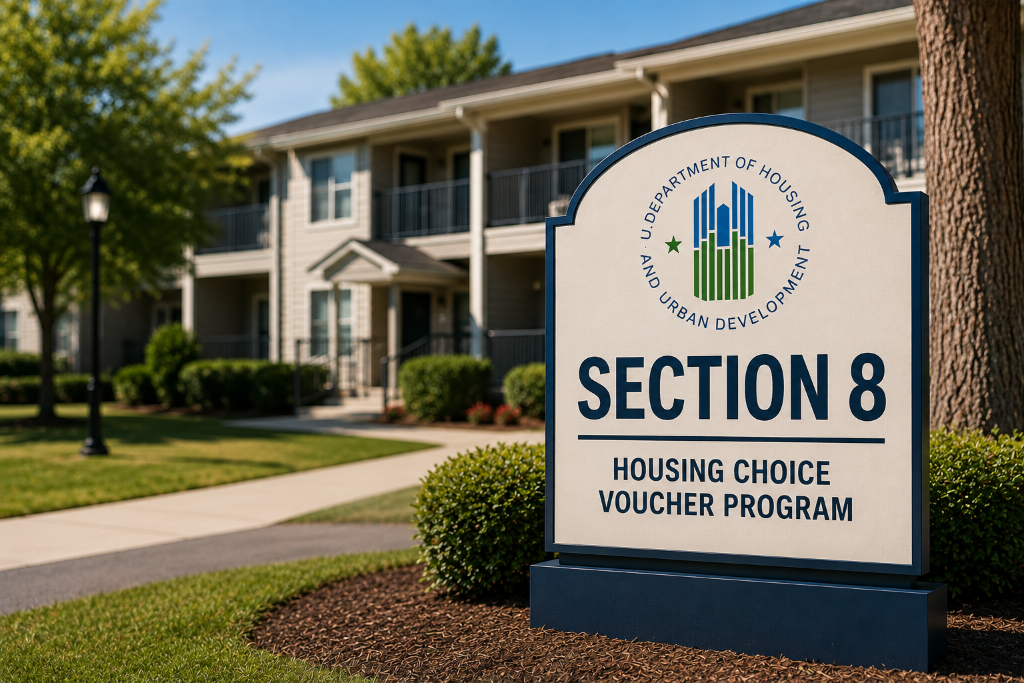
A New York appellate court says government cannot force landlords into a voluntary federal housing program when participation requires surrendering Fourth Amendment protections.
Across the country, state and local governments have adopted "source-of-income" laws intended to prevent landlords from rejecting applicants simply because their rent will be paid through Social Security, veterans' benefits, alimony, child support, or a government housing subsidy.
Some of these laws include Housing Choice Vouchers—commonly called Section 8—and effectively require landlords to participate in the federal program.
But a major New York appellate decision has now drawn a constitutional line.
In People of the State of New York v. Commons West, LLC, a unanimous appellate court ruled that New York could not force landlords to accept Section 8 vouchers when doing so also required them to consent to government inspections and broad access to their business records.
The court did not strike down the Section 8 program. It did not invalidate every source-of-income protection. It held that New York could not compel landlords to enter a program that required them to surrender Fourth Amendment rights.
The decision could influence similar disputes nationwide—and raises important questions for Florida landlords.
The ruling at a glance
| Question | Court's answer |
|---|
| Is the federal Section 8 program unconstitutional? | No |
| May landlords voluntarily participate? | Yes |
| May New York prohibit ordinary source-of-income discrimination? | Generally, yes |
| May New York force landlords to accept Section 8 under the existing program structure? | The court said no |
| Why? | Mandatory participation required consent to broad inspections and records access |
| Does the ruling automatically control Florida? | No |
| Is the case final? | Not necessarily; further appellate review is underway |
How the dispute began
New York amended its Human Rights Law in 2019 to prohibit housing discrimination based on an applicant's lawful source of income. The statutory definition included Section 8 vouchers.
Two prospective tenants later complained that companies affiliated with Ithaca Renting Company had refused to rent to Section 8 recipients.
New York Attorney General Letitia James brought an enforcement action against the landlords. The state sought:
- A permanent injunction.
- Court-ordered nondiscrimination policies.
- Civil penalties and restitution.
- Continuing court supervision.
- A requirement that the landlords reserve a percentage of their units for Section 8 recipients for three years.
The landlords argued that the state was doing more than requiring them to accept a lawful form of payment. It was forcing them to enter the federal Housing Choice Voucher program and accept every obligation contained in the mandatory Housing Assistance Payments contract.
A trial court agreed. On March 5, 2026, the New York Supreme Court's Appellate Division, Third Department, unanimously affirmed that ruling.
Accepting a voucher is not like accepting a check
The distinction is important.
A Section 8 voucher is not merely money handed to a landlord. For an owner to receive voucher payments, the owner must participate in an ongoing relationship with a local public housing agency.
The process generally requires:
- Approval of the rental unit.
- A government inspection.
- A determination that the requested rent is reasonable.
- Execution of a Housing Assistance Payments agreement, usually called a HAP contract.
- Addition of the HUD tenancy addendum to the landlord's lease.
- Continued compliance with federal program requirements.
HUD confirms that the housing agency must inspect the unit, determine whether the rent is reasonable, and participate in the required leasing documents.
Once the HAP contract is signed, the landlord has a separate contractual relationship with the housing authority. The housing authority—not the tenant—pays the subsidized portion of the rent.
The inspection requirement
Before approving a unit, the public housing agency must determine whether it satisfies federal housing-quality standards.
The inspection may include:
- The rental unit.
- Equipment serving the unit.
- Common areas.
- Building systems affecting health and safety.
- Later reinspections during the assisted tenancy.
- Additional inspections following certain complaints.
The New York court noted that federal rules require an initial inspection and periodic inspections during the tenancy. The regulations also permit inspections following complaints.
Inspections are intended to ensure that subsidized families receive decent, safe, and sanitary housing. The landlords did not dispute the government's legitimate interest in maintaining those standards.
The constitutional problem was that New York made participation mandatory while the federal contract required the owner's advance consent to government access.
The records requirement went beyond the apartment
The HAP contract also requires participating owners to provide information needed to administer the program and determine whether the rent is reasonable.
The court emphasized language requiring the owner to provide "full and free access" to the contract unit, the premises, and relevant accounts and records.
Those records can include information concerning:
- The assisted unit.
- Rent charged for comparable unassisted units.
- Other units in the same building.
- Units in other buildings owned or managed by the landlord.
- Electronic records and the equipment or facilities containing them.
A landlord who voluntarily joins the program may voluntarily accept those obligations. The constitutional question changes when the government says the landlord has no choice.
The Fourth Amendment problem
The Fourth Amendment protects people and businesses against unreasonable government searches.
Housing inspections do not always require a traditional criminal search warrant. Governments may use administrative inspection systems, but those systems must include constitutional safeguards. Consent must also be genuine—not obtained by threatening someone's ability to conduct an otherwise lawful business.
The New York court relied heavily on an earlier decision, Sokolov v. Village of Freeport. In that case, New York's highest court held that a municipality could not condition a landlord's ability to obtain a rental permit on consenting to a warrantless inspection.
The Commons West court saw the same problem here:
- State law required the landlord to accept Section 8.
- Accepting Section 8 required signing the HAP contract.
- The contract required advance consent to inspections and records access.
- The landlord could not refuse the contract without violating state law.
- Therefore, the landlord's "consent" was not genuinely voluntary.
The court concluded that New York had indirectly forced landlords to surrender constitutional protections.
Why a later challenge was not enough
New York argued that landlords could challenge an improper inspection in court.
The appellate court rejected that argument because the owner was required to sign the HAP contract—and consent to access—before any particular inspection dispute arose.
By the time the landlord tried to challenge the search, the landlord had already signed a contract purporting to authorize it.
Refusing a later inspection could also lead the housing authority to suspend or terminate housing-assistance payments before a court reviewed the dispute. The appellate panel therefore concluded that the proposed opportunity for later review did not provide adequate protection.
Could New York have solved the problem with a warrant policy?
After the original trial-court ruling, New York's housing agency adopted a policy for portions of Tompkins County. It said that when a landlord raised a Fourth Amendment objection, the agency would seek consent from another authorized person or obtain an administrative warrant.
The appellate court found that insufficient.
The policy:
- Did not apply statewide.
- Did not cover every housing authority administering vouchers.
- Was voluntary agency policy rather than binding law.
- Did not change the mandatory language in HUD's HAP contract.
The court suggested that a properly enacted consent-or-warrant procedure might produce a different result. But an informal policy could not repair a statewide statute that remained unconstitutional on its face.
What the court actually invalidated
The court declared New York's source-of-income provision unconstitutional only to the extent that it made refusing to rent to Section 8 recipients an unlawful discriminatory practice under the existing program structure.
That limitation matters.
The decision did not say:
- Section 8 itself is unconstitutional.
- Housing inspections are always unconstitutional.
- Landlords may discriminate based on race, disability, familial status, or another protected class.
- Every source-of-income law is invalid.
- A landlord who voluntarily signs a HAP contract can later disregard it.
- Other public-benefit income may be rejected automatically.
- Every local voucher program contains the same constitutional problem.
The issue was compulsory participation combined with compelled consent to searches.
Is the ruling final?
Not necessarily.
The decision came from New York's Appellate Division, Third Department—not the New York Court of Appeals, which is the state's highest court.
The New York Attorney General filed an appeal in April 2026. Until that appeal is resolved, landlords should treat the decision as highly significant but potentially subject to reversal, modification, or narrowing.
The Legislature or federal government could also attempt to revise the inspection and HAP-contract process by adding meaningful consent, warrant, and precompliance-review protections.
Why the decision could affect other states
The federal Housing Choice Voucher program operates under the same general HUD framework nationwide.
A growing number of states and municipalities have enacted laws that include housing vouchers within protected "lawful sources of income." If those laws compel landlords to sign the same federal HAP contract, the constitutional reasoning in Commons West could be raised elsewhere.
The decision is especially important because it was:
- Unanimous.
- Based on the Fourth Amendment.
- A facial challenge to the law.
- Grounded in mandatory federal contract language.
- Directed at the practical effect of the law—not merely its wording.
However, a New York state-court ruling is not automatically binding on courts in Florida or other states. Courts elsewhere may interpret the Fourth Amendment, local statutes, or voucher procedures differently.
What does this mean in Florida?
Florida does not currently classify source of income as a protected category under its statewide Fair Housing Act. Florida's protected housing classes include race, color, national origin, sex, disability, familial status, and religion.
Florida also enacted a broad landlord-tenant preemption law in 2023. Section 83.425 provides that regulation of residential tenancies and the landlord-tenant relationship is preempted to the state. The statute specifically includes the screening process used to approve tenancies.
Several Florida communities previously adopted source-of-income protections. Their continuing scope after the 2023 preemption law has not always been clear. Orange County, for example, continues to publish fair-housing materials stating that certain landlords may not discriminate based on lawful source of income.
That produces three practical rules for Florida landlords:
- There is no statewide Florida requirement that every private landlord participate in Section 8.
- A landlord must still comply with all federal and Florida protected-class requirements.
- Before rejecting a voucher applicant, check the current rules and enforcement position for the property's city and county.
The New York ruling does not automatically invalidate any Florida ordinance. It does, however, provide a constitutional argument against a law that forces participation in Section 8 without preserving meaningful Fourth Amendment protections.
Can Florida landlords advertise "No Section 8"?
That language remains risky.
Even where voucher participation is voluntary, an advertisement saying "No Section 8" can trigger complaints, testing investigations, or disputes about local law. It may also be used as evidence when an applicant claims the stated voucher policy was a proxy for discrimination based on disability, race, national origin, or familial status.
The safer approach is to publish neutral rental qualifications and evaluate each applicant under the law applicable to the property.
If the owner does not participate in the Housing Choice Voucher program, state that fact only after confirming that refusal is permitted in that jurisdiction.
Landlords may still screen voucher applicants
Accepting a housing voucher does not ordinarily mean abandoning neutral tenant qualifications.
Subject to applicable law and program requirements, landlords may generally evaluate:
- Rental history.
- Prior lease violations.
- Credit information.
- The applicant's ability to pay the tenant's portion of the rent.
- Criminal history under a lawful written policy.
- Occupancy limits.
- Prior landlord references.
- Materially false application information.
Income standards require special handling. A landlord should not demand that a voucher applicant personally earn three times the entire contract rent when the housing authority will pay a substantial portion. Any financial qualification should reasonably evaluate the applicant's responsibility for the tenant-paid share.
Standards must be applied consistently and may not be used as a disguised method of excluding voucher recipients or protected applicants.
Voluntary participation remains voluntary consent
The New York decision does not give landlords who voluntarily joined Section 8 permission to ignore the program.
A participating landlord remains bound by:
- The HAP contract.
- Housing-quality requirements.
- Inspection obligations.
- Rent-reasonableness determinations.
- Recordkeeping requirements.
- The HUD tenancy addendum.
- Restrictions on payments collected from the tenant.
- Program rules governing termination and rent adjustments.
A landlord should review these obligations before approving a voucher tenancy—not after the lease and HAP contract have been signed.
Florida landlord action checklist
If you do not currently participate
- Check state, county, and city law before responding to voucher inquiries.
- Do not use casual or inflammatory advertising language.
- Apply the same availability and application procedures to every inquiry.
- Document the lawful reason for every rejection.
- Do not confuse source of income with a federally protected characteristic.
- Obtain legal advice before relying on the New York ruling against a Florida ordinance.
If you are considering participation
- Review the entire HAP contract.
- Understand the inspection process.
- Confirm the proposed rent and payment standard.
- Determine who handles failed inspections and repair deadlines.
- Review restrictions on collecting additional rent or fees.
- Understand when housing-assistance payments may be delayed, suspended, or terminated.
- Coordinate the lease with the mandatory HUD tenancy addendum.
If you already participate
- Continue complying with the existing HAP contract.
- Maintain inspection and repair records.
- Keep assisted and unassisted rent information organized.
- Do not collect unauthorized side payments.
- Give the housing authority required notices.
- Obtain advice before refusing an inspection or records request.

Paul's Take
Section 8 serves an important purpose, and many landlords participate successfully. But participation is not simply accepting a different form of payment. It means inspections, rent approval, government paperwork, a mandatory contract, and continuing access to property and records.
The New York court recognized a basic constitutional principle: government cannot call a program voluntary and then punish a landlord for declining to join it—particularly when joining requires the owner to surrender Fourth Amendment protections.
That does not excuse discrimination, and it does not allow participating landlords to break their contracts. It means government must pursue affordable-housing goals within constitutional limits. Helping families find housing is important. So is protecting the rights of the people being ordered to provide it.
References
This guide connects to supporting Florida Landlord Network resources on:
- How the Section 8 Housing Choice Voucher Program Works
- The HAP Contract: What Landlords Agree To
- Section 8 Inspections and Housing-Quality Standards
- Screening Applicants With Housing Vouchers
- Calculating Income Requirements for Voucher Tenants
- Source-of-Income Discrimination in Florida
- When Government Inspectors May Enter Rental Property
- Section 8 Rent, Deposits, Fees, and Side-Payment Rules
- What Happens When Housing-Assistance Payments Stop
- Section 8 Evictions and Required Notices
Disclaimer: This article provides general educational information and is not legal advice. The New York ruling is not binding on Florida courts and remains subject to further review. Housing providers should verify the current federal, state, and local requirements governing the property before changing voucher policies.