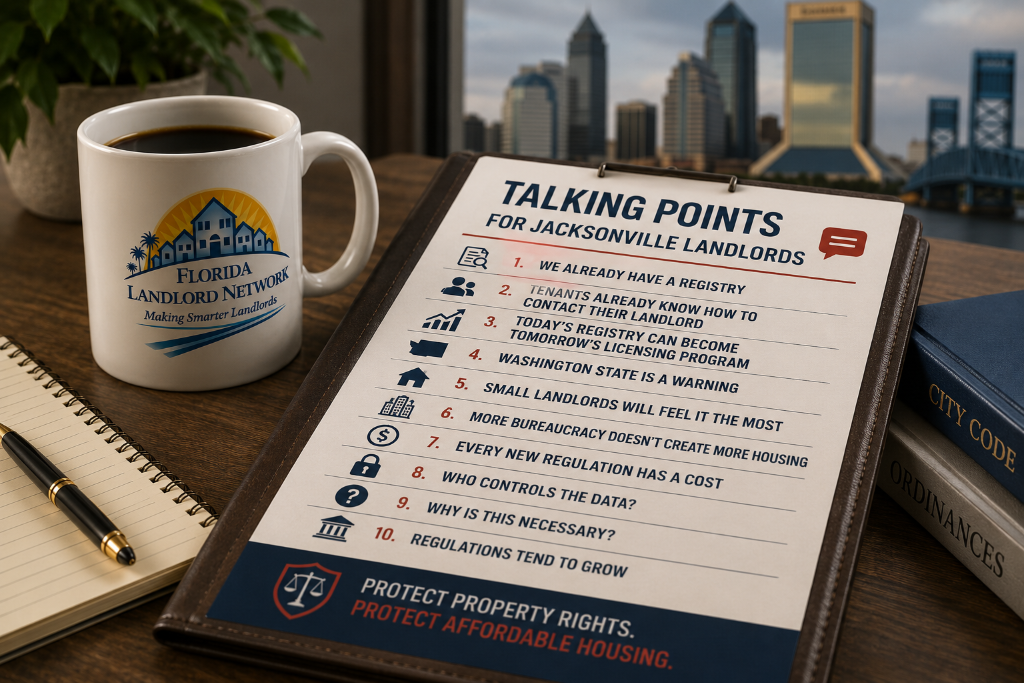
Talking Points for Jacksonville Landlords
Rental Registry Proposal
1. We Already Have a Registry
Duval County already maintains public property ownership records through the Property Appraiser and Clerk of Court. Anyone can determine who owns a rental property.
Question to ask:
If the information already exists, why do we need another government database?
Florida law already requires landlords to provide tenants with contact information. Landlords and tenants communicate through:
- Property showings
- Rental applications
- Lease agreements
- Rent collection
- Email
- Text messages
- Tenant portals
- Maintenance requests
- Lease renewals
- Legal notices
Creating another government database doesn't improve communication that already exists.
3. Today's Registry Can Become Tomorrow's Licensing Program
Across the country, landlord registries often evolve. The pattern is remarkably consistent:
- Registration →
- Annual Fees →
- Mandatory Inspections →
- Licensing →
- Additional Regulations →
- Civil Penalties
Many cities began with a "simple registry" that later expanded into expensive regulatory programs.
4. Washington State Is a Warning
A recent report from Washington State illustrates how landlord regulations can expand over time. What often begins as paperwork eventually becomes:
- Administrative penalties
- Technical violations
- Increased compliance costs
- Additional reporting requirements
Jacksonville should learn from the experiences of other cities before creating another layer of regulation.
5. Small Landlords Will Feel It the Most
Large apartment companies can hire compliance staff. Most Jacksonville landlords own only a few rental homes.
Every new:
- Form
- Fee
- Inspection
- Annual renewal
- Registration requirement
Takes time and money. Those costs ultimately increase housing costs.
6. More Bureaucracy Doesn't Create More Housing
Jacksonville needs more housing—not more paperwork. If we want additional rental housing, we should encourage investment instead of increasing barriers to owning rental property. The easier it is to provide housing, the more housing becomes available. (Note: The 2 Billion dollars we gave the the Jags, would have built more than 13,000 single family homes)
7. Every New Regulation Has a Cost
Government programs rarely remain free. Today's proposal may involve little or no fee. Tomorrow's council can easily add:
- Registration fees
- Inspection fees
- Renewal fees
- Licensing fees
- Reinspection fees
- Administrative penalties
Once the infrastructure exists, expanding it becomes much easier.
8. Who Controls the Data?
A landlord registry raises important questions:
- Who maintains the database?
- Who has access?
- Is the information public?
- How is it secured?
- How long is it retained?
- Can it be shared with other agencies?
- Why is Legal Aid controlling the database?
- What happens after future administrations take office?
These questions deserve answers before any registry is created.
9. Why Is This Necessary?
Ask city officials one simple question:
- What specific problem does this registry solve that cannot already be solved using existing public records and existing landlord-tenant laws?
- If there is a problem, identify it first.
- Then determine whether a registry is actually the best solution.
10. Regulations Tend to Grow
History shows that government programs rarely become smaller. What starts as:
- "It's just a registry."
- "It's only an inspection."
- "It's only a license."
- "It's only an annual fee."
Eventually landlords spend more time complying with regulations than serving residents.
Closing Statement (2-Minute Version)
I respectfully ask the Council to carefully consider the long-term consequences of creating a landlord registry. Across the country, many of these programs started with good intentions but gradually expanded into licensing systems, inspection programs, annual fees, and additional regulations. Jacksonville already has public property ownership records, and Florida law already requires landlords to provide tenants with contact information. Before creating another layer of government, let's first determine what problem we're trying to solve and whether existing laws already provide the solution. Our community needs more affordable rental housing—not additional barriers for the people providing it.

One point I would add today that wasn't in our earlier draft is this: The question isn't whether the first version of the ordinance is reasonable. The real question is what City Council—or a future City Council—will be able to do with the registry once it's been created.
History around the country shows that registries often become the foundation for inspections, licensing, fees, and additional regulations. That's why many landlords are concerned now, before the system is put in place. That concern isn't about today's proposal alone—it's about the precedent it sets for the future.
And perhaps most important of all, why is Legal Aid running the show?