Many Florida landlords assume that because they are simply renting a house, condominium or duplex they own, they are not operating a "business" that requires a local business license.
Depending on where the property is located, that assumption can be wrong.
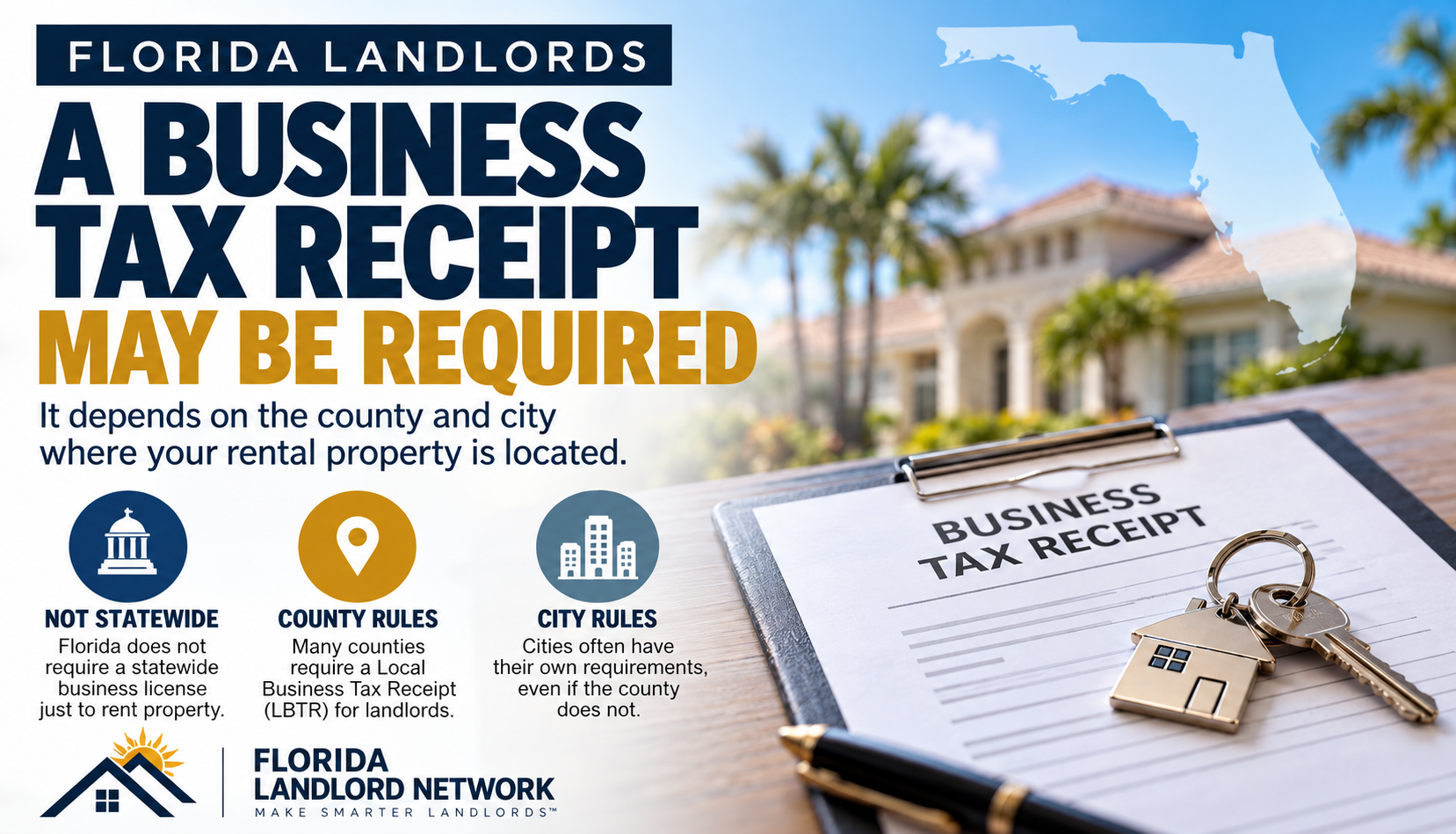
Florida does not have a statewide business license that every residential landlord must obtain. Instead, Florida law allows counties and municipalities to levy a Local Business Tax, formerly known as an occupational license tax. The document issued after payment is generally called a Local Business Tax Receipt (LBTR).
Under Chapter 205, Florida Statutes, counties and municipalities may levy a tax for the privilege of engaging in or managing a business, profession or occupation within their jurisdictions.
The complication for landlords is that each local government decides how rental activity fits into its classifications.
Renting Property Can Be Considered a Business
Some Florida jurisdictions expressly classify residential rental property as a business.
For example, Osceola County actually publishes an application specifically for "Short/Long Term Rental" Local Business Tax Receipts. Its Tax Collector states that anyone operating a business within the county must obtain an LBTR, and properties within Kissimmee or St. Cloud can also be subject to municipal requirements.
Broward County similarly states that anyone doing business in the county, including sole proprietors and home-based businesses, generally needs a county Local Business Tax Receipt. Broward's classifications include apartments and rooming houses. Municipalities can impose additional requirements.
Miami-Dade County provides an interesting example of why landlords cannot rely on a simple statewide rule. Its current tax schedule lists apartments containing one to four units as not taxable, while apartment operations with five or more units are subject to the county business tax.
Long-Term and Short-Term Rentals Aren't Always Treated the Same
Another major distinction is the length of the rental.
Charlotte County's Tax Collector specifically says a rental-property owner must pay the county Local Business Tax when the property is available for rental periods of less than six months. That means its published rental rule is directed at transient or shorter-term rentals rather than the ordinary annual residential lease.
Polk County is even more explicit.
A property rented for six months or less requires a Class B county Local Business Tax Receipt for each rental location. But Polk says other real-estate rental businesses generally do not need a separate county receipt for every long-term rental property. Instead, the rental business needs a receipt for the location from which the business is conducted. Polk also says an owner of non-short-term rental property who turns all rental operations over to a properly licensed management business may not need a county LBTR.
Palm Beach County likewise expressly requires an LBTR for accommodations offered for short-term rental, with a separate application for each rental unit.
Those distinctions are important. A rule applying to an Airbnb or vacation rental should not automatically be assumed to apply to a landlord renting a house under a conventional one-year lease.
The City May Have a Different Rule Than the County
This is where the issue becomes particularly confusing.
Even when a county does not impose a business tax on a particular long-term rental, the municipality where the property is located may do so.
The City of Tampa, for example, expressly says that an owner renting a house, apartment, rooming house or similar property for private gain must obtain a Business Tax Receipt. Tampa repealed its separate rental-certificate requirement in 2023, but states that the Business Tax remains due on residential and commercial rental properties.
Hollywood requires owners of rented single-family homes, townhouses, condominiums and duplexes to obtain Local Business Tax Receipts and treats each single-family building as a separate business location.
St. Cloud has an application specifically titled "Landlord-Rental Property Local Business Tax Receipt." The application covers single-family houses, duplexes and other rental properties.
Other municipalities with explicit residential-rental BTR requirements include places such as Miami Shores and Lantana.
This is why saying simply that "Florida landlords need a business license" — or that they do not — is inaccurate.
What About Jacksonville and Duval County?
Jacksonville/Duval County imposes a Local Business Tax on most businesses and states that home-based and one-person businesses are included. The Tax Collector also distinguishes Jacksonville from Jacksonville Beach, Atlantic Beach, Neptune Beach and Baldwin, where municipal requirements can apply in addition to the county requirements.
That distinction has become particularly important for rental owners in Jacksonville Beach, where enforcement of Local Business Tax requirements against residential rental properties has recently become an issue.
For Jacksonville-area landlords, therefore, the precise location of the rental property matters. "Duval County" by itself is not necessarily enough to determine the answer.
Florida County Quick Reference
The following is a working FLN guide based on current official information. "County LBTR" means the county imposes a general Local Business Tax; it does not necessarily mean every owner of one long-term rental owes the tax. Rental classifications and municipal requirements must still be checked.
| County | Current guidance for residential landlords |
|---|
| Alachua | Check county classification and municipality |
| Baker | Check municipality/local classification |
| Bay | Check county and municipality |
| Bradford | Check municipality/local classification |
| Brevard | County LBTR system — most businesses covered |
| Broward | County LBTR — rental classifications exist; municipality may also require one |
| Calhoun | Check municipality/local classification |
| Charlotte | Rental LBTR specifically required for rentals under 6 months |
| Citrus | County LBTR system; rental classification should be confirmed for long-term rentals |
| Clay | Check county/local classification |
| Collier | County LBTR system; separate receipt generally required for each taxable business location |
| Columbia | County LBTR system |
| DeSoto | Check county/local classification |
| Dixie | Check municipality/local classification |
| Duval | County/consolidated-city LBTR system; Beaches municipalities may impose additional requirements |
| Escambia | Check county/local classification |
| Flagler | County LBTR system; municipal receipt may also be required |
| Franklin | Check municipality/local classification |
| Gadsden | Check county/local classification |
| Gilchrist | Check municipality/local classification |
| Glades | Check municipality/local classification |
| Gulf | Check municipality/local classification |
| Hamilton | Check municipality/local classification |
| Hardee | Check county/local classification |
| Hendry | Check county/local classification |
| Hernando | Check county/local classification |
| Highlands | Check county/local classification |
| Hillsborough | County LBTR system; Tampa expressly taxes residential rental activity |
| Holmes | Check municipality/local classification |
| Indian River | $40 county LBTR in unincorporated county; municipalities have their own rules |
| Jackson | Check municipality/local classification |
| Jefferson | Check municipality/local classification |
| Lafayette | Check municipality/local classification |
| Lake | Check county/local classification |
| Lee | Check county/local classification |
| Leon | Check county/local classification |
| Levy | Check municipality/local classification |
| Liberty | Check municipality/local classification |
| Madison | Check municipality/local classification |
| Manatee | Check county/local classification |
| Marion | Check county/local classification |
| Martin | County LBTR system; municipal receipt may also be required |
| Miami-Dade | Apartments: 1–4 units county-tax exempt; 5+ units taxable under county schedule; municipalities may impose additional requirements |
| Monroe | Check county/local rental classification |
| Nassau | Check county/local classification |
| Okaloosa | County LBTR system; confirm rental classification |
| Okeechobee | Check county/local classification |
| Orange | Most businesses require county BTR; municipalities may additionally require one |
| Osceola | Yes — county has a specific short- and long-term rental LBTR application |
| Palm Beach | County LBTR system; short-term rentals expressly require one per rental unit |
| Pasco | Check county/local rental classification |
| Pinellas | Check county plus municipality; several Pinellas municipalities impose rental BTRs |
| Polk | Short-term: LBTR per property. Long-term: different treatment; generally business location rather than each rental property |
| Putnam | Check county/local classification |
| Santa Rosa | Check county/local classification |
| Sarasota | Check county/local classification |
| Seminole | Check county/local classification |
| St. Johns | County LBTR system; zoning and municipal requirements can also apply |
| St. Lucie | County BTR required for businesses/professions located in county; city BTR also required where applicable |
| Sumter | Check county/local classification |
| Suwannee | Check county/local classification |
| Taylor | Check municipality/local classification |
| Union | Check municipality/local classification |
| Volusia | Check county and municipality |
| Wakulla | Check county/local classification |
| Walton | Check county/local classification |
| Washington | Check municipality/local classification |
Important
The entries marked "check" do not mean that no tax is required. They mean we would not tell an FLN landlord that a long-term rental requires a county business tax without first verifying the property's particular county and municipality.
That is especially important because Florida has 67 counties but hundreds of municipalities, and a landlord can comply with the county rule while still violating a city requirement.
This Is Not the Same as a Rental Registry
There is another important distinction.
A Local Business Tax Receipt is primarily a tax mechanism. A rental-property registration program is generally a regulatory program that may require the landlord to register individual properties, provide ownership/contact information, undergo inspections, designate responsible parties or comply with other conditions.
Florida's Attorney General has previously recognized the distinction between a Chapter 205 Local Business Tax and separate regulatory rental-registration fees.
That distinction matters whenever a local government proposes a new rental registry. The fact that landlords may already pay a Local Business Tax does not automatically mean an existing LBTR and a proposed rental registry are legally or functionally the same program.

Paul's Take
Florida has made this unnecessarily difficult for independent landlords.
A person owning one rental house should be able to determine, without hiring an attorney or digging through several layers of county and municipal codes, whether a license, tax receipt or registration is required.
Instead, Florida has a patchwork. One county may tax only short-term rentals. Another may treat five apartments differently from four. A city may require a rental-property Business Tax Receipt even when the county treats the same property differently.
For landlords, the practical rule is simple:
Never assume that owning a long-term rental automatically requires a business license — but never assume that it doesn't. Check both the county and the municipality where the rental property is physically located.
Florida Landlord Network will continue expanding its county-by-county reference so independent landlords can determine what applies to their property without having to navigate dozens of government websites.