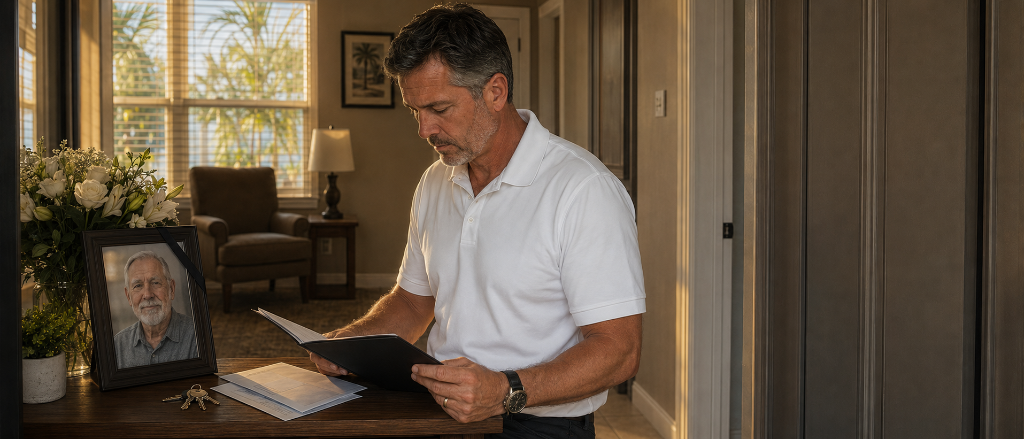
A tenant's death does not automatically give the landlord possession of the rental property. Florida law establishes strict rules governing access, personal belongings, probate representatives, and when the locks may be changed.
The death of a tenant creates a difficult situation for everyone involved. Grieving relatives may want immediate access to the home, while the landlord needs to protect the property and eventually prepare it for another tenant.
Compassion is important—but so is following the law.
A landlord who gives the wrong person access, removes belongings prematurely, or assumes the rental has been abandoned can face substantial liability. The safest response is to secure the property, document everything, and determine who has legal authority to act for the deceased tenant.
First Question: Was This the Last Remaining Tenant?
Florida's special rules apply when the person who died was the last remaining tenant.
If another tenant named on the lease is still living in the rental, the tenancy ordinarily continues. The surviving tenant remains responsible for the rent and the other obligations of the lease.
If the deceased person was the only remaining tenant, however, the landlord must determine how possession can legally be recovered.
The tenant's death, standing alone, does not authorize the landlord to change the locks, empty the rental, or begin preparing it for a new tenant.
Do Not Automatically Give the Family Access
One of the most common mistakes is allowing a relative or friend into the rental merely because that person says, "I'm the tenant's daughter," or "I'm handling everything."
Being a family member, emergency contact, beneficiary, or healthcare surrogate does not necessarily give someone legal authority over the tenant's property.
Even possession of the tenant's will may not be enough. A will identifies the deceased person's wishes, but the probate court generally must appoint someone to administer the estate.
Likewise, a power of attorney ordinarily terminates when the person who granted it dies.
Before giving anyone unrestricted access or allowing belongings to be removed, the landlord should request documentation showing that the person has been appointed by a court as the estate's personal representative, sometimes commonly called the executor.
This protects the landlord from later claims that valuables, documents, family heirlooms, firearms, cash, or other property were given to the wrong person.
When a Personal Representative Has Been Appointed
A court-appointed personal representative has the legal authority to act for the tenant's estate.
The landlord should obtain and retain a copy of the court documentation confirming that appointment. Once authority is verified, the landlord can communicate with the personal representative about:
- Payment of rent and other outstanding charges.
- Removal of the tenant's belongings.
- Returning possession of the rental.
- The security deposit.
- Damage to the property.
- Termination or resolution of the lease.
The landlord should get any surrender of possession in writing. The document should clearly identify the property, confirm that possession is being returned, address remaining belongings, and be signed by the properly authorized representative.
Florida's 60-Day Rule
Florida law provides a specific method for recovering possession when the last remaining tenant has died.
Under Florida Statutes §83.59(3)(d), a landlord may recover possession without an eviction action when all of the following conditions exist:
- The last remaining tenant is deceased.
- Personal property remains in the rental.
- Rent is unpaid.
- At least 60 days have passed since the tenant's death.
- The landlord has not received written notice that a probate estate exists or the name and address of a personal representative.
Every requirement matters. The landlord should not treat the unit as legally recoverable under this provision unless all five conditions have been satisfied.
The statute also excludes certain federally administered or regulated housing programs. Landlords dealing with subsidized or federally regulated housing should obtain legal guidance before acting.
What If the Rental Appears Empty?
An apparently empty rental presents a different question. It may indicate that possession has been surrendered or that the property has been abandoned—but appearances can be misleading.
A relative may have removed belongings without legal authority. Someone may still have keys. Important documents or property may remain in closets, cabinets, garages, storage areas, or vehicles.
Before changing the locks, the landlord should carefully document the condition of the rental and obtain legal guidance about whether the facts establish surrender or abandonment under Florida law.
Do not use the tenant's death as a shortcut around Florida's possession requirements.
What Happens to the Tenant's Belongings?
Recovering possession of the rental and disposing of the tenant's belongings are related—but legally separate—issues.
A landlord should review the lease for the statutory abandoned-property language authorized by Florida Statutes §83.67. The provision must address recovery of possession following the death of the last remaining tenant.
When the proper language appears in the rental agreement, the landlord may be protected from responsibility for storing or disposing of personal property after legally recovering possession.
If the lease does not contain the required language, the landlord may need to follow the notice, storage, and disposition procedures contained in Chapter 715, Florida Statutes.
Landlords should not assume that waiting 60 days automatically authorizes them to throw everything away. The lease language and the method by which possession was recovered must both be examined.
If the Tenant Died Inside the Rental
When a death occurred inside the unit—particularly when decomposition or biological contamination is present—the landlord should not attempt an ordinary cleanup.
A properly licensed and insured biohazard-remediation company should evaluate and clean the affected areas. Contaminated materials may need to be removed for health and safety reasons, but that does not necessarily authorize the removal of unrelated personal property.
The landlord should photograph the condition of the premises, preserve invoices and reports, notify the insurance carrier when appropriate, and avoid exposing employees or contractors to biological hazards.
The tenant's death does not erase Florida's security-deposit requirements.
After possession is returned, the landlord must account for the deposit in accordance with Florida Statutes §83.49. Any claim for unpaid rent, property damage, cleaning, or other lawful charges must be handled within the statutory deadlines.
Communications and payments should be directed to the properly authorized representative of the estate—not simply to whichever relative contacts the landlord first.
A Practical Checklist
When notified that a tenant has died:
- Confirm the tenant's identity and date of death.
- Determine whether another named tenant remains in possession.
- Secure the property against unauthorized entry without unlawfully retaking possession.
- Photograph and document the condition of the rental.
- Do not release keys or belongings based only on a claim of kinship.
- Request court documentation from anyone claiming to represent the estate.
- Keep all communications in writing.
- Review the lease's abandoned-property provision.
- Calendar the 60-day date, if §83.59(3)(d) may apply.
- Consult a Florida landlord-tenant attorney before changing locks or disposing of property.
- Follow Florida's security-deposit procedures after possession is legally returned.

Paul's Take
A tenant's death is not an ordinary lease violation. A family may be grieving, confused, and trying to deal with a lifetime of belongings while also navigating a probate system they may not understand.
A good landlord can be patient, respectful, and helpful without ignoring the law.
Do not hand the keys to the first relative who arrives—but do explain why you need proper documentation. Do not rush to empty the home—but do protect it and carefully record its condition. And when someone has been legally authorized to represent the estate, work cooperatively toward a prompt and dignified resolution.
This is one of those moments when doing the job correctly and doing the right thing should be the same thing.
This article provides general information for Florida rental-property owners and is not legal advice. Unusual circumstances, federally regulated housing, contested estates, unauthorized occupants, or disputes over possession should be referred to a qualified Florida attorney.