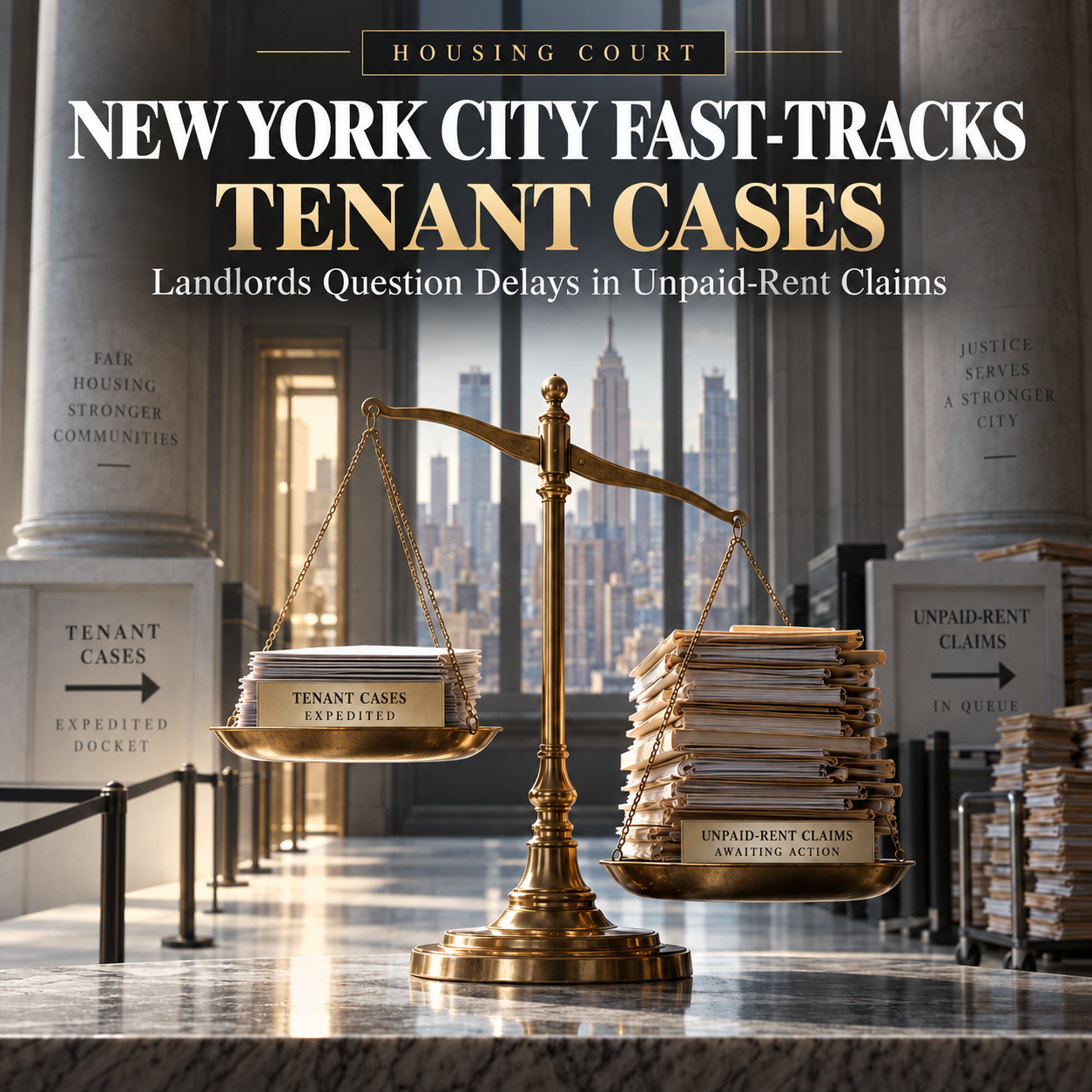
New York City has launched an expedited Housing Court process for tenants confronting severe or immediately dangerous housing conditions.
Mayor Zohran Mamdani's administration praised the initiative as an important component of its broader "Fix the City" housing campaign. The fast track was established through a directive from the New York State Unified Court System, rather than by City Hall acting alone.
Under the new procedure, qualifying cases may receive an initial court appearance within approximately five days.
Which Cases Receive Priority?
The fast track does not apply to every tenant complaint. It is intended for Housing Part proceedings involving particularly urgent conditions, including:
- Buildings subject to vacate orders following fires, floods or other disasters
- Building-wide hazardous conditions
- Extended elevator outages affecting vulnerable residents
- Lack of heat, water or other essential services
- Proceedings seeking the appointment of a court-supervised administrator under Article 7-A
City officials say tenants facing dangerous conditions have sometimes waited weeks or months for hearings, repairs or permission to return to their homes.
"Every day, New Yorkers walk through the doors of this courthouse, some of whom are living in explicitly dangerous conditions and cannot afford to do so for a day longer," Mamdani said when announcing the initiative. The administration describes the policy as a way to concentrate judicial attention on cases involving an immediate threat to health or safety. New York City's announcement explains the government's reasoning.
Landlords Ask: What About Unpaid Rent?
Property owners are not necessarily objecting to emergency cases receiving prompt attention. Their central complaint is that the same sense of urgency has not been applied to nonpayment proceedings.
New York landlords reportedly file as many as 120,000 unpaid-rent cases annually. Initial appearances can take approximately 50 days, while contested cases may remain unresolved considerably longer.
The 120,000 figure is better understood as the approximate annual volume of nonpayment filings—not necessarily 120,000 cases currently sitting unresolved in a single verified backlog. Nevertheless, the number illustrates the scale of the problem confronting Housing Court.
Landlord advocates argue that tenants unable to live safely in an apartment deserve prompt judicial relief—but owners unable to collect rent also need timely access to the courts.
Without rental income, property owners must still pay mortgages, taxes, insurance, utilities, maintenance employees and contractors. Smaller landlords may lack the financial reserves necessary to carry a nonpaying tenancy through months or years of litigation.
Critics therefore see the fast track as evidence of an increasingly uneven system: tenant-initiated enforcement cases receive accelerated treatment while owners seeking to enforce lease-payment obligations remain trapped in the ordinary court calendar.
A Larger Concern About Private Rental Housing
The debate extends beyond court scheduling.
Mamdani, a democratic socialist, has supported a rent freeze for rent-stabilized apartments and a larger role for government and nonprofit entities in affordable housing. Members of his administration have also advocated transferring chronically distressed properties away from negligent owners and into some form of public or nonprofit stewardship.
Supporters contend these policies are needed to protect tenants and address New York's affordability crisis. Property-rights advocates worry that the cumulative effect will discourage private ownership and investment.
A rental property cannot remain financially viable indefinitely when rent collection becomes uncertain, operating expenses continue to rise and owners cannot obtain timely relief through the courts.
The predictable results may include deferred maintenance, mortgage defaults, distressed sales and a reduction in the number of individuals willing to provide rental housing. Large institutional owners may be able to absorb extended litigation more easily than someone who owns a two-, four- or ten-unit building.

Paul's Take
Dangerous housing conditions should be corrected promptly. No responsible landlord benefits from allowing tenants to remain in a building without heat, water, a working elevator or protection from serious hazards.
But a functioning court system cannot recognize urgency only when the tenant is the petitioner.
Failure to pay rent is not merely an accounting disagreement. Rental income finances the repairs, utilities, insurance and personnel necessary to keep housing safe. When owners must wait months for a first appearance—and potentially much longer for a final resolution—the financial health of the entire property is placed at risk.
New York's fast-track initiative may provide necessary relief in true emergencies. The more important question is whether the city and state will bring comparable urgency to the massive nonpayment docket.
For landlords nationwide, New York remains an important warning. When government expands tenant protections without preserving an owner's practical ability to collect rent and enforce a lease, it risks weakening the very housing supply it is trying to protect.