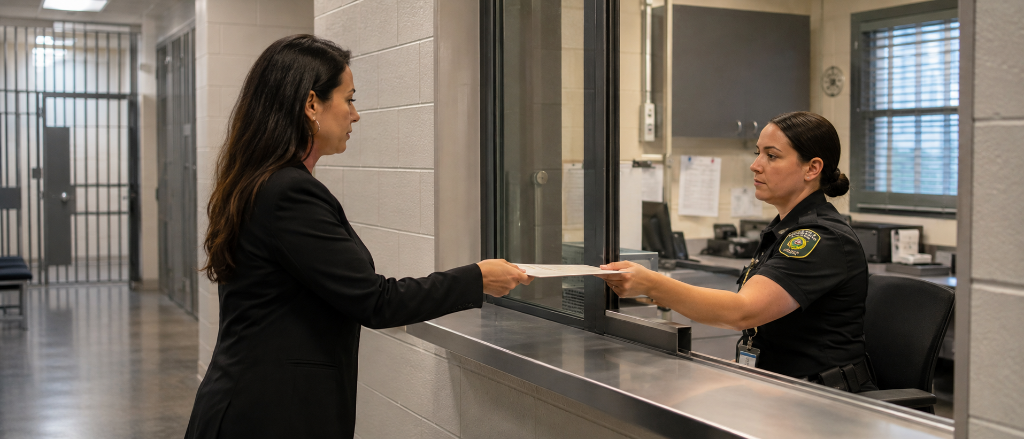
Filing an eviction or other civil lawsuit does not automatically place the defendant under the court's authority. The plaintiff must ensure that the summons and complaint are properly delivered by the sheriff or another person legally authorized to serve process.
That responsibility does not disappear because the defendant has been arrested or is being held in jail.
If the plaintiff knows—or learns—that the defendant is incarcerated, the plaintiff should promptly identify the correct facility and arrange for service there. Proceeding against an incarcerated defendant without making a reasonable effort to serve that person can delay the case and may jeopardize any judgment eventually entered.
Filing the Lawsuit Is Only the Beginning
The clerk issues the summons, and the sheriff or authorized process server physically delivers it. But the plaintiff remains responsible for providing sufficient information, paying the service fee, monitoring the result, and taking further action if the first attempt is unsuccessful.
Florida Rule of Civil Procedure 1.070 generally requires the plaintiff to cause original process to be served within 120 days after filing the complaint. Failure to complete service may result in dismissal unless the plaintiff demonstrates good cause or the court grants additional time. Florida Rules of Civil Procedure
In practical terms, the plaintiff should not assume that the clerk, sheriff, jail, or court will locate a defendant automatically.
Personal Service Is Still Possible in Jail
Florida law ordinarily requires original process to be delivered directly to the defendant or served through another method specifically authorized by law. Section 48.031, Florida Statutes, provides the general requirements for personal service. §48.031, Florida Statutes
For someone confined in a Florida state prison, the law is particularly direct:
"Process against a state prisoner shall be served on the prisoner."
That requirement appears in §48.051, Florida Statutes.
A person in a county jail is generally served personally under §48.031. The paperwork must ordinarily be directed to the sheriff or authorized process server serving the county in which the jail or correctional facility is located.
The Sheriff in the Correct County Must Receive the Process
Section 48.021, Florida Statutes, generally provides that process is served by the sheriff of the county where the person is found, subject to provisions allowing special or certified process servers. Chapter 48, Florida Statutes
That distinction is important. A lawsuit may be pending in Duval County while the defendant is being held in the Clay County Jail, the Orange County Jail, or a Florida Department of Corrections institution elsewhere in the state.
In that situation, the plaintiff may need to obtain an alias or reissued summons and send the service package to the sheriff or authorized process server in the county where the defendant is actually confined.
The Jacksonville Sheriff's Office, for example, expressly states that its Civil Unit can serve process only within Duval County. Jacksonville Sheriff's Office Civil Process Unit
County requirements vary, but a service request involving an incarcerated defendant should ordinarily include:
- The defendant's complete legal name and any known aliases.
- Date of birth or another identifying detail.
- Inmate or booking number, if available.
- Full name and address of the jail or correctional institution.
- The defendant's housing location, if known.
- The issued summons and the required copies of the complaint.
- Written instructions identifying the defendant as an inmate.
- The required sheriff's service fee.
- The case number and plaintiff's contact information.
Florida law sets the sheriff's fee for serving a summons or writ in a civil case at $40 for each summons or writ served. The fee is generally nonrefundable, including when service is unsuccessful. §30.231, Florida Statutes
Before sending the documents, the plaintiff should contact the appropriate sheriff's civil-process office. Some agencies require a cover letter, additional copies, payment in a particular form, or facility-specific instructions.
Confirm the Defendant's Location
Inmates are frequently transferred, released, or moved from a county jail into state custody. A service request sent to yesterday's location may be returned unserved today.
The plaintiff should therefore verify the defendant's custody status immediately before requesting service. Useful official resources include:
- The appropriate county sheriff's inmate-search system.
- The Florida Department of Corrections Offender Search.
- The clerk's criminal-court records, when publicly available.
- Direct confirmation from the correctional facility or sheriff's civil-process office.
A screenshot or printed record of the inmate search can also document the plaintiff's efforts if the court later asks what was done to locate and serve the defendant.
Eviction Posting Does Not Solve Every Service Problem
Section 83.22, Florida Statutes, permits an eviction summons to be posted at the rental premises under certain circumstances. The sheriff must first make at least two attempts to obtain service, with at least six hours between the attempts. If statutory conditions are satisfied, the summons may then be attached to the premises, with additional copies mailed through the clerk. §83.22, Florida Statutes
But a plaintiff should not treat posting as a substitute for serving a defendant at a known jail location.
If the plaintiff knows that the tenant is incarcerated, the safest course is to disclose that location and arrange personal service at the facility. A plaintiff who learns of the incarceration after posting should consider obtaining another summons and completing personal service before requesting a default. The court should also be told about the defendant's known location.
Posting may be sufficient for the possession claim when every statutory requirement has been met. It generally should not be relied upon to obtain a personal money judgment for unpaid rent, damages, or other amounts. A money judgment ordinarily requires personal jurisdiction over the defendant, which is commonly established through personal service or the defendant's voluntary appearance.
Florida appellate courts repeatedly emphasize that proper service is ordinarily necessary for a court to obtain personal jurisdiction. A judgment entered without valid service may later be declared void. Third District Court of Appeal discussion of personal jurisdiction
Do Not Ignore an Unserved Return
When the sheriff returns the summons marked "not found," "moved," "incarcerated," or "unable to serve," the plaintiff should act immediately:
- Read the return of service carefully.
- Verify the defendant's current custody location.
- Request an alias or reissued summons from the clerk if necessary.
- Send the process to the correct county sheriff or authorized process server.
- Confirm that service was completed.
- Make sure the return of service is filed in the court record.
- Do not request a default until valid service is shown.
A statement on the return that the defendant is in jail is not proof that the defendant was served. It is information telling the plaintiff where the next attempt may need to be made.

Paul's Take
Proper service is not merely a technical requirement. We are asking a judge to remove someone from their home. That is no small thing, and it should never be treated casually.
When a tenant owes the landlord a substantial amount of money, it can understandably color the landlord's thinking. But the tenant still has legal rights, including the right to know that a lawsuit has been filed and the opportunity to respond.
The fact that someone is in jail does not mean that person has been convicted of a crime. In a criminal case, the accused is presumed innocent unless proven guilty. In the eviction case, incarceration does not relieve the landlord of the obligation to follow the law.
Landlords have the right to recover possession when the rent has not been paid. Tenants have the right to proper notice and lawful court procedures. Those principles are not in conflict. They are both part of the same system of justice.
As Americans, we must stand up for the legal rights of everyone—even when doing so requires additional time or effort. Serving an incarcerated tenant properly is not only the legally prudent thing to do. It is the fair and decent thing to do.