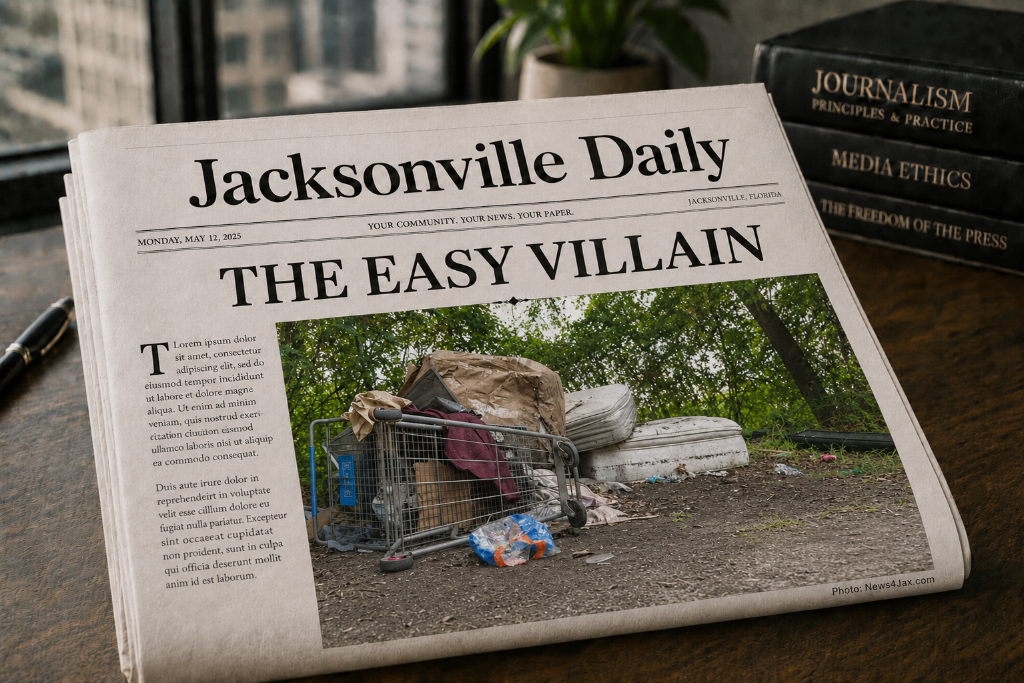
Jacksonville's proposed rental-property registry has received the kind of sustained and favorable news coverage normally associated with an active legislative campaign.
News stories repeatedly emphasize troubled tenants, absentee landlords, eviction filings, code violations, and endorsements from researchers and legal advocates. The proposed registry is commonly presented as a practical answer to those problems—often before its requirements, costs, or legal authority have been established.
What the coverage rarely emphasizes is the most important fact:
Jacksonville currently has no active rental registry legislation before the City Council.
- The only formal proposal was withdrawn unanimously more than a year ago.
- No replacement ordinance has been introduced.
- No registration requirements have been published.
- No fees or penalties have been proposed.
- No committee hearing is currently scheduled.
That raises a fair question:
Are local news outlets simply reporting on the proposal—or helping its supporters build the political momentum needed to enact it?
The Headlines Tell One Story
Consider the progression of News4JAX coverage.
In April 2025, the station reported that Councilman Jimmy Peluso wanted a registry "to help hold owners accountable." The story associated the proposal with unsafe housing, absentee landlords and Jacksonville's eviction numbers.
In September 2025, News4JAX reported that Peluso was preparing to reintroduce legislation "as residents struggle to find help." The story began with a leading question:
"What if there was a way you could always reach your landlord if you needed to?"
In January 2026, another report announced that Jacksonville Area Legal Aid would spearhead the registry and maintain information about rental properties and their owners. The report also discussed creating an ombudsman position to guide tenants through city services.
Peluso said he hoped the program would be operating within approximately three months.
Most recently came another supportive headline:
"Research and Legal Advocacy Back New Rental Property Registry."
Individually, each story can be defended as reporting on a matter of public interest.
Viewed together, however, the coverage consistently adopts the language, assumptions and examples promoted by registry supporters.
The Council Record Tells Another Story
The official legislative history is much less dramatic.
Councilman Jimmy Peluso introduced Resolution 2025-293 in April 2025. Importantly, the resolution did not create a registry. It merely encouraged Mayor Donna Deegan to establish one.
Questions soon arose regarding whether the Mayor even possessed the legal authority to create such a program without a City Council ordinance.
As a result:
- May 19, 2025: Both assigned committees voted to withdraw the resolution.
- May 27, 2025: The full City Council withdrew it unanimously, 17–0.
That remains the Council's last formal action on the proposal.
Despite repeated news reports discussing renewed efforts, a new bill, JALA operating the registry, and implementation timelines, no replacement ordinance has been introduced. As of July 20, 2026, no rental-registry hearing appears on the City Council legislative calendar. Advocacy has continued. Legislative action has not. That distinction deserves far greater prominence.
Support Is Presented as Validation
The claim that "research and legal advocacy" support the registry deserves closer examination. The organizations being cited are not necessarily neutral evaluators. They are among the proposal's supporters. These include:
- Jacksonville Area Legal Aid
- The JAX Rental Housing Project
Both organizations contribute valuable information to housing discussions. Their opinions deserve consideration. However, their support alone does not establish that a registry would be:
- Necessary?
- Lawful?
- Cost-effective?
- Successful?
More important questions remain unanswered:
- Has anyone demonstrated that registries reduce eviction filings?
- Would they increase rent collections?
- Would they provide Code Compliance with powers it does not already possess?
- Would participation be mandatory?
- Would landlords pay registration or renewal fees?
- Would recurring inspections be required?
- Would complaints become public before verification?
- What penalties would exist for failing to register?
- How much taxpayer money would fund the program?
- What prevents future expansion?
Those questions remain unanswered because no ordinance has been filed for public review.
Existing Laws Receive Less Attention
Florida law already requires landlords—or their authorized representatives—to provide tenants with contact information for receiving notices and process. State law also maintains public property-ownership records through the Property Appraiser's Office. Jacksonville's municipal code already addresses housing standards, code enforcement, and tenant remedies.
Coverage occasionally mentions these existing resources. More often, however, it frames the issue as an accessibility problem rather than asking why existing laws are not being enforced.
If the problem is:
- Noncompliance → enforce existing law.
- Confusing public records → improve public access.
- Weak code enforcement → strengthen Code Compliance.
None of those solutions necessarily requires creating a citywide rental registry.
Bad Properties Make Powerful Television
News4JAX has highlighted several apartment complexes with serious maintenance issues. Those tenants deserve help. Landlords who ignore dangerous conditions deserve enforcement. But damaged apartments also make compelling television.
The policy question is whether those isolated cases justify regulating thousands of responsible landlords—many owning only one or two rental homes. That connection is often assumed rather than demonstrated.
A registry will not:
Journalism Should Examine Both Sides
This is not an argument against investigative reporting. Quality journalism exposes neglect and holds government accountable. It should also maintain a clear distinction between covering legislation and promoting it.
Balanced reporting would examine:
- Implementation costs,
- Privacy concerns,
- Duplication of existing records,
- Legal authority,
- Effects on small landlords,
- Future registration fees,
- Inspections,
- Penalties.
Most importantly, every story should begin with the proposal's current status: No active ordinance exists.
The previous proposal was withdrawn unanimously. That is not a procedural footnote. It is the central fact.
Let the Public See the Ordinance
Before Jacksonville embraces a rental registry, the public deserves to review the proposal itself.
Among the unanswered questions:
- Who must register?
- What information must be disclosed?
- Who controls the database?
- How is accuracy maintained?
- What will it cost?
- Who pays?
- What penalties apply?
Until those questions are answered in a publicly filed ordinance, Jacksonville has a media campaign and an advocacy campaign—but not an operating rental registry.

Paul's Take
Bad landlords should absolutely be held accountable. Legitimate tenant complaints deserve prompt attention. But sustained news coverage should never substitute for evidence—or for the legislative process itself. Jacksonville already has landlord-disclosure laws, public ownership records, housing standards, and code-enforcement authority.
Before creating another government-supported database, city leaders should first explain why existing tools are inadequate—and why enforcing current law would not be the better place to begin.
Sources
- Jacksonville City Council Resolution 2025-293
- News4JAX (April 2025)
- News4JAX (September 2025)
- News4JAX (January 2026)
- Florida Statute §83.50